
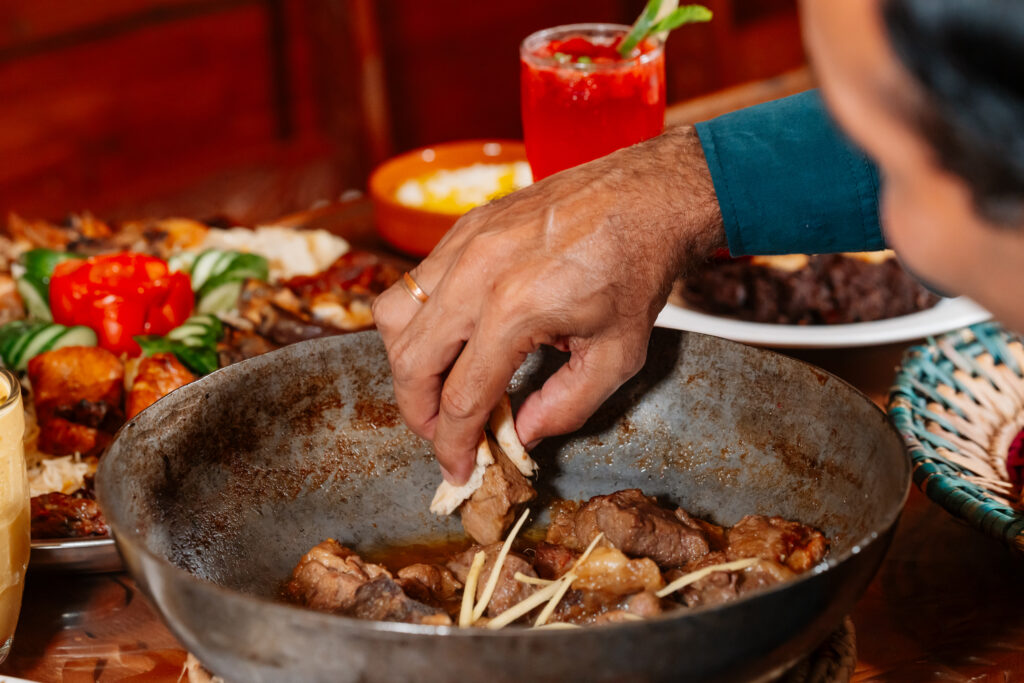
There is a reason lamb works so naturally in a karahi. The meat brings its own richness, the tomatoes provide freshness, ginger and green chillies sharpen the flavours, and direct heat pulls everything together without needing an overly complicated masala.
For diners searching for lamb karahi in Dubai, the Peshawari approach is particularly distinctive. Instead of hiding the lamb beneath a thick gravy, the cooking keeps the meat at the centre of the experience.
At Namak Mandi UAE, this philosophy can be tasted in Gud Shinwari Karahi, a signature dish prepared with lamb and cooked over fire. It reflects the wider Pashtun belief behind the menu: use fresh meat, keep the seasoning purposeful and let the fire do its work.
Why Lamb Works So Well in a Karahi
Lamb has enough natural character to stand up to direct heat without requiring a heavy sauce.
That matters in Peshawari cooking.
When the ingredient list is relatively restrained, the diner notices the meat more clearly. You can recognise its richness, texture and the way it has absorbed the freshness of the tomato, ginger and chilli around it.
A heavily sauced lamb dish can still be enjoyable, but the experience is different. In a Peshawari karahi, the goal is not to make the sauce louder than the lamb.
The meat should still be the first thing you taste.
This is why lamb karahi appeals to diners who enjoy meat-led Pakistani food rather than dishes where the gravy becomes the main attraction.
The Peshawari Approach Starts with Restraint
Pakistani cuisine contains countless spice combinations, and different regions prepare karahi in very different ways.
Peshawari food is notable for what it chooses not to add.
Coarse salt, tomatoes, ginger and green chillies provide much of the supporting character. Rather than building a long list of powdered spices, the cook relies more heavily on fresh ingredients, the quality of the meat and control of the heat.
That does not make the dish plain.
In fact, using fewer ingredients places greater pressure on every element. Tomatoes need to cook down properly. The lamb needs to remain tender. The chilli must bring freshness without overpowering the meat.
Simplicity only works when the ingredients and technique are good enough to carry it.
Fresh Lamb Changes the Entire Dish
With lamb karahi, freshness matters because there is nowhere for the meat to hide.
If the lamb is tough or poorly handled, a restrained Peshawari preparation will expose that immediately. The diner notices the texture long before they start thinking about spice.
Namak Mandi’s wider food philosophy is built around freshly prepared lamb and chicken with no frozen shortcuts.
That commitment is particularly relevant to karahi.
A good lamb karahi should feel like meat cooked with tomato and fire—not tomato sauce with pieces of meat added into it.
The difference may sound small, but it changes how every bite feels.
What Happens to Tomatoes in a Lamb Karahi?
Tomatoes have an important job in Peshawari karahi.
They provide moisture at the beginning of cooking and then gradually reduce around the meat. As the liquid cooks away, the tomato becomes more concentrated and begins to coat the lamb rather than sitting as a separate sauce.
This is why a good karahi does not need to arrive swimming in gravy.
The tomato should have done its work by the time the dish reaches the table.
It brings acidity that cuts through the natural richness of lamb while also creating enough body for the juices to gather around the meat.
With warm Dodai nearby, very little else is required.
Ginger and Green Chilli Keep the Lamb Fresh
Lamb has a naturally rich flavour, so supporting ingredients need to provide contrast.
Fresh ginger brings warmth and aroma.
Green chillies provide a clean heat that feels different from the deeper flavour of large quantities of powdered chilli.
Together, they help keep lamb karahi from becoming heavy.
This is an important feature of the Peshawari style. The aim is not simply to create heat for the sake of it. Each ingredient should make the lamb taste clearer.
That is why an authentic Pashtun-style karahi can feel bold without being overloaded with spice.
Fire Makes Peshawari Lamb Karahi Different
Ingredients tell only half the story. The other half happens underneath the karahi.
Direct flame affects how quickly moisture reduces and how the lamb interacts with the tomato and other fresh ingredients.
At Namak Mandi, the karahi experience is connected to open-fire cooking rather than treating fire as a decorative concept.
The result is also sensory.
The pan approaches while still holding its heat. You hear the sizzling first. The aroma rises quickly, and the table usually begins reaching for the bread before everyone has decided who is serving.
That moment is part of what makes karahi different from an ordinary plated curry.
It feels connected to the cooking process.
Gud Shinwari Karahi: The Lamb Karahi to Start With
For someone trying Peshawari lamb karahi for the first time at Namak Mandi, Gud Shinwari Karahi is the natural starting point.
The official Namak Mandi menu describes it as slow-cooked lamb, seared on fire and finished with tomato.
This combination reflects the key characteristics of Peshawari cooking:
- Fresh lamb at the centre
- Direct fire
- Tomato supporting rather than drowning the meat
- Restrained seasoning
- A dish designed to be shared
Instead of ordering several karahis on your first visit, let Gud Shinwari Karahi become the centre of the Dastarkhwan and choose contrasting dishes around it.
That gives you a clearer understanding of the Namak Mandi style.
Lamb Karahi vs Lamb Curry
Both can be rich meat dishes, but they are not the same experience.
A lamb curry may be designed around a generous gravy, a layered spice base or a slower sauce-driven preparation. The gravy often becomes an important part of what is served with rice or bread.
Lamb karahi is usually more concentrated.
The meat, tomato and fresh ingredients cook directly together in the pan, and the finished dish tends to put more visual and flavour emphasis on the lamb.
A simple comparison helps:
| Feature | Lamb Karahi | Lamb Curry |
| Main focus | Lamb and direct pan cooking | Lamb and surrounding gravy |
| Sauce | Concentrated around the meat | Often more generous |
| Cooking style | Karahi over direct heat | Varies widely |
| Tomato | Commonly reduced closely with meat | May form part of a broader curry base |
| Best pairing | Fresh bread; rice optional | Bread or rice |
| Eating style | Shared directly from the karahi | Often served from a bowl or plate |
There are many regional exceptions, but the distinction helps first-time diners understand what they are ordering.
Lamb Karahi vs Mutton Karahi
Lamb and mutton are sometimes used interchangeably in casual restaurant searches, but technically they describe different meat.
Lamb refers to meat from a younger sheep, while mutton traditionally refers to meat from a mature sheep.
The difference can influence flavour and texture.
For diners, the most reliable approach is to follow the restaurant’s actual menu description rather than assuming that every “mutton” search result refers to the same meat.
At Namak Mandi, Gud Shinwari Karahi is specifically identified as lamb.
That makes lamb karahi the accurate description when discussing this signature dish.
Why Dodai Is the First Thing to Order with Lamb Karahi
Rice can work with karahi, but bread is often the most direct way to enjoy it.
Fresh Dodai allows you to gather the reduced tomato, juices and pieces of lamb directly from the shared pan.
The bread also helps keep the meal communal.
One person tears it. Someone moves the karahi closer. Another reaches across the table for a piece of lamb.
There is no need to divide everything immediately into separate plates.
At Namak Mandi, this style of eating fits naturally with the wider Peshawari Dastarkhwan.
For two or three diners, Gud Shinwari Karahi with Dodai may already form the core of a satisfying meal.
Add Chapli Kabab for a Completely Different Texture
If you want another meat dish, choose contrast rather than simply adding a second karahi.
Authentic Chapli Kabab provides that contrast.
The broad, textured kabab has a firmer surface and crisp edges, while lamb karahi is softer and surrounded by concentrated juices.
Eating the two together makes each one more noticeable.
For someone being introduced to Pashtun food, the pairing is particularly useful because it shows two different traditions from the same regional cuisine without making the table unnecessarily large.
Charcoal-Grilled Lamb Brings Fire in Another Form
A larger family can introduce another lamb preparation through the grill.
Premium Gud Chops, Vreeta BBQ or Vreeta Dum BBQ add charcoal character to the meal.
This gives the group two very different expressions of lamb.
The karahi is built around the hot pan, tomato and direct flame.
The grilled dishes bring char, smoke and a firmer exterior.
For a family that particularly enjoys lamb, combining the two makes more sense than ordering several karahis with only minor differences between them.
Add Peshawari Pulao Mandi for a Bigger Table
Rice becomes useful when the group grows.
Peshawari Pulao Mandi can provide a central rice dish while Gud Shinwari Karahi and grilled lamb sit around it.
One guest may prefer lamb karahi with Dodai. Another may take the same lamb with rice. Someone else can focus on the charcoal-grilled meat.
This gives everyone flexibility without turning the meal into a collection of individual orders.
For a family of four or five, consider:
- Gud Shinwari Karahi
- Peshawari Pulao Mandi
- Authentic Chapli Kabab
- Premium Gud Chops or Vreeta BBQ
- Dodai
That is already a generous table with distinct cooking styles.
Lamb Karahi and Pashtun Melmastia
A karahi feels particularly natural within Pashtun hospitality because it is designed to stay in the centre.
The entire table shares it.
That connects with Melmastia, the Pashtun tradition of generously welcoming and honouring a guest.
At Namak Mandi, every diner is treated as a Mehmaan—an honoured guest.
The Dastarkhwan is not only about feeding people. It is about making the table feel generous enough that nobody has to ask whether there is enough to share.
Karahi, Dodai, rice and grilled meat all reinforce that spirit.
Once the main meal slows down, Sheena Kahwa gives guests another reason to stay and continue the conversation.
Lamb Karahi for Families and Group Dining
Lamb karahi works particularly well for groups because a single pan can serve as the centrepiece of a much larger meal.
For two or three diners:
- Gud Shinwari Karahi
- Dodai
- Authentic Chapli Kabab
For a family:
- Add Peshawari Pulao Mandi
- Add one charcoal-grilled dish
For a larger gathering:
- Consider another karahi according to preferences
- Add a Mix Grill Platter
- Order additional rice and Dodai as required
Namak Mandi also accepts bulk orders and guest event enquiries, making the same style of Peshawari food suitable for family occasions and larger gatherings.
Where to Try Lamb Karahi in Dubai
Diners looking for traditional lamb karahi in Dubai can visit Namak Mandi in Al Nahda First.
Namak Mandi Dubai – Al Nahda
Hessa Tower, Al Ittihad Street
Al Nahda First, Dubai, UAE
Opening hours: Daily, 11:00 AM–1:00 AM
Call or WhatsApp: 050 464 9204
Parking is available at Hessa Tower, while Al Nahda Metro is approximately a five-minute walk away.
The location is also convenient for diners travelling from nearby areas of Sharjah.
The Dubai branch offers dine-in, takeaway, delivery by call, bulk orders and guest event bookings.
Lamb Karahi and Peshawari Dining in Abu Dhabi
Namak Mandi also brings its Peshawari food tradition to Mussafah, Abu Dhabi.
Guests can build a shared meal around Gud Shinwari Karahi, Peshawari Pulao Mandi, Chapli Kabab, charcoal-grilled meats and freshly prepared Dodai.
A private dining room is available for family occasions, corporate meals and groups that prefer a more private setting.
Namak Mandi Abu Dhabi – Mussafah
4th Thiqah Street, M-17
Mussafah Sanaiya, Abu Dhabi, UAE
Opening hours: Daily, 10:30 AM–12:00 midnight
Call or WhatsApp: 050 371 7639
Frequently Asked Questions
What is lamb karahi?
Lamb karahi is lamb cooked in a karahi, the rounded metal pan that gives the dish its name. Peshawari versions typically emphasise fresh meat, tomato, ginger, green chilli and direct heat rather than a heavy gravy or complicated spice mixture.
What is the best lamb karahi to try at Namak Mandi?
Gud Shinwari Karahi is Namak Mandi’s signature lamb karahi. It is prepared with lamb, cooked over fire and finished with tomato, making it a strong introduction to the restaurant’s Peshawari meat-first approach.
Is lamb karahi very spicy?
Peshawari lamb karahi does not need to be extremely spicy. Green chilli provides heat, but the defining flavours are the lamb, tomato, ginger and direct cooking. The aim is to keep the meat noticeable rather than overwhelm it.
What should I eat with lamb karahi?
Fresh Dodai or Tandoori Dodai is a natural pairing. For a larger meal, add Authentic Chapli Kabab, Peshawari Pulao Mandi and a charcoal-grilled lamb dish such as Premium Gud Chops.
Where can I find lamb karahi in Dubai?
Namak Mandi Dubai serves Gud Shinwari Karahi at Hessa Tower on Al Ittihad Street in Al Nahda First. Parking is available, and Al Nahda Metro is approximately a five-minute walk away.
Does Namak Mandi serve lamb karahi in Abu Dhabi?
Namak Mandi also operates in Mussafah, Abu Dhabi. Guests can enjoy the restaurant’s Peshawari menu and contact the branch on 050 371 7639 for reservations, private dining and group enquiries.
Gather Around a Lamb Karahi in Dubai
If lamb karahi is what brings you to the table, experience it through the Peshawari principle that makes the dish distinctive: fresh meat, restrained seasoning and fire strong enough to let every ingredient speak clearly.
Order Gud Shinwari Karahi with warm Dodai, add Authentic Chapli Kabab or charcoal-grilled lamb, and share the meal around a proper Namak Mandi Dastarkhwan.
Call or WhatsApp 050 464 9204 for Dubai reservations, family dining and group orders at Namak Mandi Al Nahda. For Abu Dhabi bookings and private dining, contact Namak Mandi Mussafah on 050 371 7639.
Explore the menu at www.namakmandidubai.com. Follow @namakmandidubai and @namakmandi.abd on Instagram for sizzling karahis, live-fire lamb and restaurant updates.
Bring the Mehmaan. We will bring the karahi to the fire.
This Is Not Just Food. This Is Peshawar.

