
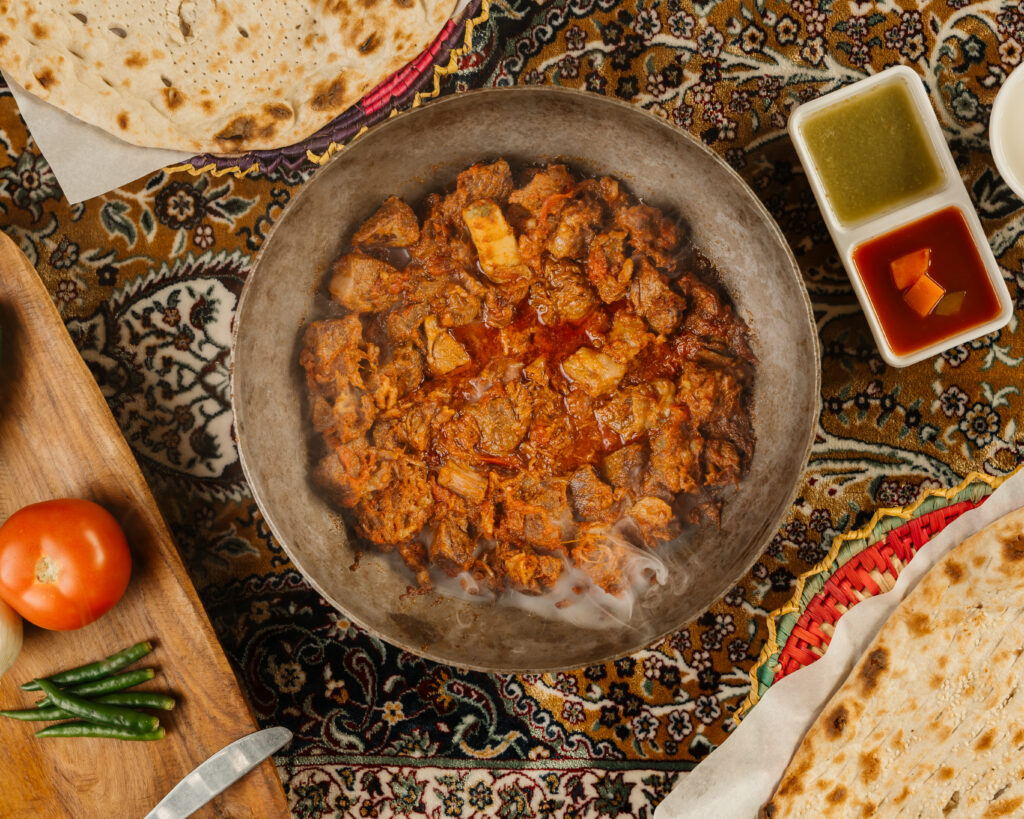
A good karahi is difficult to ignore when it reaches the table. The pan is still hot, the tomatoes have cooked down around the meat, fresh ginger and green chilli lift the aroma, and warm bread is usually being torn before anyone has finished serving the first portion.
For diners searching for karahi gosht in Dubai, authenticity is not simply about how spicy the dish is. The quality of the meat, the karahi itself, the control of the heat and the balance between fresh ingredients all matter.
At Namak Mandi UAE, the Peshawari approach is represented by Gud Shinwari Karahi: fresh lamb cooked over fire with a deliberately simple flavour profile. It reflects a central principle of Peshawari cuisine—the meat should remain the focus rather than disappear beneath a heavy masala.
What Does Karahi Gosht Mean?
Gosht means meat, while karahi refers to the rounded, wok-like pan in which the dish is traditionally cooked.
So karahi gosht is, quite literally, meat prepared in a karahi.
That simple explanation, however, does not capture why the dish has such a strong identity in Pakistani food culture.
The karahi is not merely a serving bowl. Its shape and the high heat used during cooking affect how quickly ingredients reduce, how the meat cooks and how the tomatoes develop around it. Pakistani karahi is commonly associated with direct, high-heat cooking and a comparatively straightforward approach that allows tomato and meat flavours to remain noticeable.
Recipes vary widely across Pakistan. Lahore, Karachi, Peshawar and individual families all have their own preferences. Authenticity therefore does not mean that every karahi must follow one identical ingredient list.
It means the dish should make sense within the regional style it claims to represent.
The Karahi Pan Is Part of the Dish
One of the easiest mistakes is to think that any meat curry can become karahi simply by transferring it into a metal pan before serving.
Traditional karahi is defined partly by how it is cooked.
The wide cooking surface exposes ingredients to strong heat. Tomatoes can reduce rather than remain watery, while the meat cooks directly with the ingredients around it.
This produces a different texture from a large pot of gravy simmered slowly with plenty of liquid.
The finished karahi should feel concentrated rather than diluted.
At Namak Mandi, this connection to fire is taken seriously. The restaurant describes every karahi as freshly cooked over open flame rather than relying on shortcuts.
That heat becomes part of the experience. The pan arrives still holding the energy of the kitchen rather than feeling like a curry that has simply been reheated and transferred for presentation.
Fresh Meat Should Remain at the Centre
Authentic karahi gosht begins with the meat.
A dish using relatively simple seasoning gives poor-quality meat nowhere to hide. Texture, freshness and the way the meat has responded to the cooking process become immediately noticeable.
This is particularly important in Peshawari and Shinwari-style karahi.
Namak Mandi’s Gud Shinwari Karahi is prepared with fresh lamb, and the restaurant’s wider food philosophy emphasises fresh lamb and chicken rather than frozen shortcuts.
The aim is straightforward: when you take a bite, you should still recognise the flavour and texture of the meat.
A karahi should not become a bowl of masala where every piece tastes exactly like the sauce surrounding it.
Tomatoes Do More Than Create Gravy
Tomatoes are one of the most important elements in many Pakistani karahi preparations.
But they should not simply create a large amount of tomato sauce.
Under strong heat, tomatoes soften, break down and reduce around the meat. Their moisture helps the cooking process, while their acidity and natural sweetness contribute balance.
The key is reduction.
As the excess liquid cooks away, the tomato becomes more closely integrated with the meat. The final dish feels concentrated and glossy rather than watery.
This is one reason authentic karahi should not automatically be judged by how much gravy appears in the pan.
For someone accustomed to curry, a relatively dry karahi may initially look unusual. Once eaten with warm bread, however, the logic becomes clear.
There is enough concentrated flavour around the meat without needing a bowlful of sauce.
Ginger and Green Chilli Bring Fresh Character
Another recognisable feature of Peshawari-style karahi is the role of fresh ginger and green chilli.
Ginger brings warmth and fragrance without making the dish taste like a powdered spice blend.
Green chillies contribute freshness and heat.
Used with restraint, these ingredients allow the meat and tomatoes to remain distinct rather than making every bite taste aggressively spicy.
This is an important point for people trying karahi gosht for the first time: authentic does not automatically mean extremely hot.
A well-made karahi should have character and warmth, but the chilli should not completely erase the taste of the lamb or chicken.
Heavy Spicing Is Not Always a Sign of Authenticity
Pakistani cuisine contains many beautifully spiced dishes, but more spice does not automatically mean more authenticity.
Peshawari cuisine often takes the opposite approach.
At Namak Mandi, the brand deliberately describes its food as avoiding heavy spices so the quality of the meat can remain central.
This is especially relevant to Gud Shinwari Karahi.
Its appeal comes from the relationship between lamb, tomato, direct heat and simple seasoning. Adding layer after layer of spice would change the very character that makes the dish Peshawari.
This also explains why diners familiar with another regional karahi may find Shinwari-style cooking noticeably different.
Neither version needs to be declared superior. They represent different regional preferences.
Karahi Gosht vs Regular Meat Curry
A diner unfamiliar with Pakistani food may reasonably ask: is karahi gosht simply another meat curry?
Not quite.
A traditional gravy-based curry may use more liquid, a longer-cooked spice base or ingredients intended to create a generous sauce.
Karahi is more closely associated with direct pan cooking and reduction.
The meat and tomato mixture remains concentrated, and the cooking vessel itself plays an important role in achieving the final texture.
The comparison can be simplified like this:
| Feature | Karahi Gosht | Gravy-Based Meat Curry |
| Cooking style | High-heat pan cooking | Often slower pot cooking |
| Main texture | Concentrated around the meat | More generous gravy |
| Tomato role | Cooked down closely with meat | May form part of a larger sauce |
| Meat | Usually remains highly prominent | May share attention with gravy |
| Best pairing | Fresh bread, with rice optional | Bread or rice |
| Serving style | Often served in the karahi | Usually served from a bowl or pot |
There are many exceptions, but the table helps explain why the two experiences should not be treated as interchangeable.
What Makes Gud Shinwari Karahi Different?
At Namak Mandi, Gud Shinwari Karahi represents the restaurant’s strongest expression of Peshawari karahi cooking.
The official brand description highlights fresh lamb, fire and tomato rather than an elaborate masala.
That simplicity changes what diners pay attention to.
You notice the tenderness of the lamb.
You notice how the tomato has reduced around it.
You notice the heat of the pan and the fresh character of the supporting ingredients.
Rather than trying to impress through complexity, the dish depends on restraint.
For a first visit to Namak Mandi, it makes sense to order Gud Shinwari Karahi before exploring several other meat dishes. It gives you a clear understanding of the cooking philosophy behind the restaurant.
Dodai Is the Natural Companion
A hot karahi and fresh bread belong together.
At Namak Mandi, Dodai or Tandoori Dodai can be torn by hand and shared around the table.
The bread gathers the concentrated juices around the meat without requiring the karahi to contain a large amount of gravy.
It also changes the way the meal is enjoyed.
Instead of every person receiving an individual portion immediately, the karahi remains in the centre. Bread moves around the table. Guests take meat according to appetite.
This is the Peshawari Dastarkhwan in practice.
For two or three people, Gud Shinwari Karahi and Dodai can already create a satisfying shared meal before any additional dishes are added.
Add Chapli Kabab for Texture
If the group wants a second meat dish, Authentic Chapli Kabab is more interesting than simply ordering another similar karahi.
The two preparations offer clear contrast.
Karahi is hot, tender and coated in reduced tomato juices.
Chapli Kabab has a broad shape with a more textured exterior.
Alternating between the two keeps the meal varied without requiring an oversized menu.
For first-time guests, the combination also introduces two different traditions closely connected with Peshawari and Pashtun food culture.
Charcoal-Grilled Lamb Brings Another Side of Fire
A larger table can add a charcoal-grilled item.
Premium Gud Lamb Chops, Vreeta BBQ or Vreeta Dum BBQ show what happens when Peshawari meat cooking moves from the karahi to the grill.
Gud Shinwari Karahi carries the character of direct heat inside the pan.
Charcoal-grilled meat introduces smoke, char and a firmer exterior.
That gives a family table genuine contrast rather than several dishes differentiated only by name.
For a group, a well-balanced spread could include:
- Gud Shinwari Karahi
- Authentic Chapli Kabab
- Premium Gud Lamb Chops or Vreeta BBQ
- Dodai
- Peshawari Pulao Mandi
Each dish then has a clear purpose.
Should You Eat Karahi Gosht with Rice?
You can, but rice is not essential.
For a smaller meal, freshly prepared Dodai may be all the karahi needs.
For families and larger groups, Peshawari Pulao Mandi can provide a shared rice base alongside the karahi and grilled meat.
The rice is particularly useful when guests have different preferences. Someone may eat mostly karahi and bread, another may pair lamb with rice, while another concentrates on barbecue.
That flexibility is one reason Peshawari-style dining works well for groups.
Everyone shares the same Dastarkhwan without needing the same plate.
Karahi Gosht and Melmastia
The dish becomes even easier to understand when viewed through Pashtun hospitality.
Melmastia is the tradition of generously welcoming and honouring a guest.
At Namak Mandi, diners are treated as Mehmaan—honoured guests.
Karahi naturally supports this culture because the entire pan can be placed in the centre for everyone to share.
Nobody needs to guard an individual portion.
Bread is passed. Rice is shared. Another piece of meat is offered across the table.
Once the main dishes are finished, Sheena Kahwa allows the gathering to continue at a slower pace.
The experience shows why authenticity is not only about recreating ingredients. It is also about understanding how the food is meant to bring people together.
Where to Try Authentic Karahi Gosht in Dubai
For diners looking for Peshawari-style karahi gosht in Dubai, Namak Mandi is located in Al Nahda First.
The location is convenient for residents of Al Nahda and diners travelling from nearby areas of Sharjah.
Parking is available at Hessa Tower, while Al Nahda Metro is approximately a five-minute walk away.
Namak Mandi Dubai – Al Nahda
Hessa Tower, Al Ittihad Street
Al Nahda First, Dubai, UAE
Opening hours: Daily, 11:00 AM–1:00 AM
Call or WhatsApp: 050 464 9204
The Dubai branch offers dine-in, takeaway, delivery by call, bulk orders and guest event bookings.
Peshawari Karahi in Abu Dhabi
Namak Mandi also serves its Peshawari menu in Mussafah, Abu Dhabi.
Families and groups can enjoy Gud Shinwari Karahi alongside Chapli Kabab, charcoal-grilled meats, Peshawari Pulao Mandi and Dodai.
A private dining room is also available for family occasions, corporate meals and group gatherings.
Namak Mandi Abu Dhabi – Mussafah
4th Thiqah Street, M-17
Mussafah Sanaiya, Abu Dhabi, UAE
Opening hours: Daily, 10:30 AM–12:00 midnight
Call or WhatsApp: 050 371 7639
Frequently Asked Questions
What is karahi gosht?
Karahi gosht is meat cooked in a karahi, the rounded pan that gives the dish its name. Pakistani versions commonly use tomato, meat and fresh aromatics, with regional styles differing in spice level, gravy and preparation.
What makes an authentic Pakistani karahi?
A good karahi should reflect its regional style, use carefully prepared meat and allow the cooking process to remain noticeable. High heat, tomato reduction and a concentrated texture are common characteristics, although recipes vary widely across Pakistan.
Is Peshawari karahi very spicy?
Not necessarily. Peshawari and Shinwari-style karahi often relies on restrained seasoning, fresh tomato, ginger and green chilli rather than a heavy powdered-spice mixture. The meat remains one of the dominant flavours.
What meat is used in Gud Shinwari Karahi at Namak Mandi?
Namak Mandi describes its Gud Shinwari Karahi as a fresh lamb dish cooked over fire and finished with tomato. It should therefore be referred to as lamb rather than inaccurately labelled as mutton.
What should I order with karahi gosht?
Begin with fresh Dodai or Tandoori Dodai. For a larger table, add Authentic Chapli Kabab, Premium Gud Lamb Chops and Peshawari Pulao Mandi to experience different textures and cooking methods.
Where can I find Peshawari karahi in Dubai?
Namak Mandi serves Gud Shinwari Karahi at Hessa Tower on Al Ittihad Street in Al Nahda First. The branch is approximately a five-minute walk from Al Nahda Metro and is convenient for diners coming from nearby Sharjah.
Experience Karahi Gosht Around a Peshawari Dastarkhwan
If your search for karahi gosht is about finding fresh meat, concentrated flavour and a karahi that still carries the heat of the fire, make Gud Shinwari Karahi the centre of your next Peshawari meal.
Pair it with warm Dodai, Authentic Chapli Kabab and charcoal-grilled lamb, then gather your Mehmaan around the same Dastarkhwan.
Call or WhatsApp Namak Mandi Dubai on 050 464 9204 for reservations, family meals and group orders. For Abu Dhabi dining and private-group enquiries, contact Namak Mandi Mussafah on 050 371 7639.
Explore the menu at www.namakmandidubai.com. Follow @namakmandidubai and @namakmandi.abd on Instagram for sizzling karahis, Frontier fire and restaurant updates.
Fresh meat. Fierce fire. A karahi made to be shared.
This Is Not Just Food. This Is Peshawar.

