
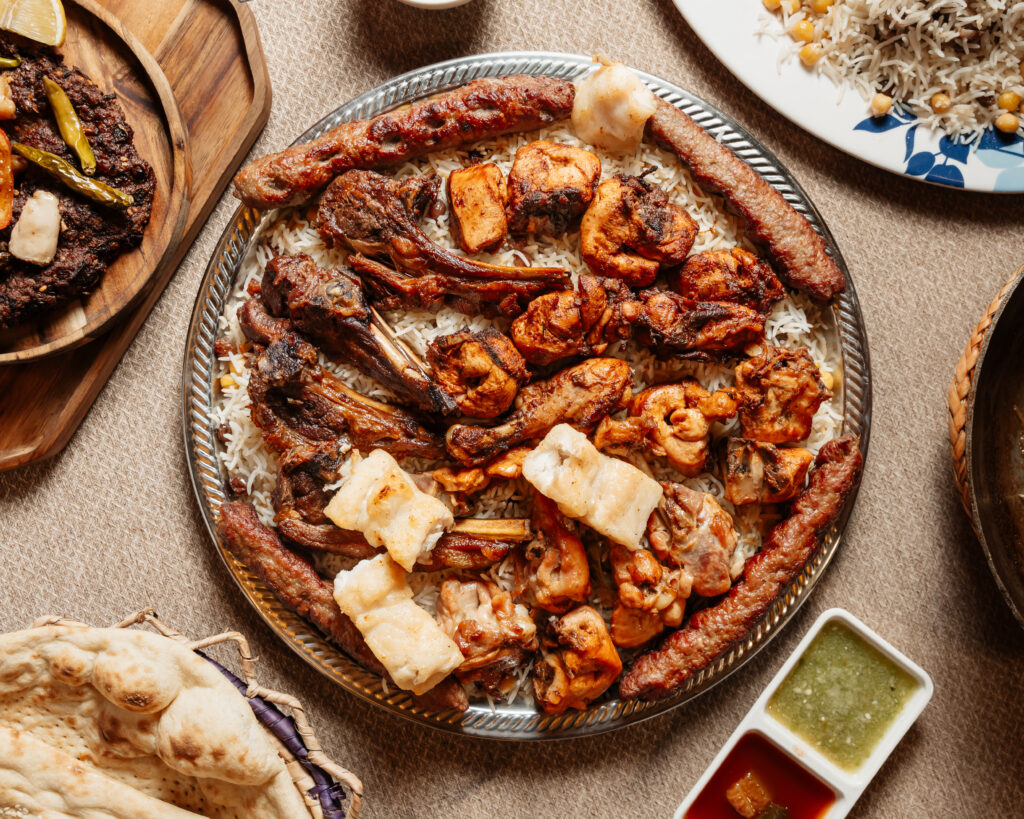
Place kabsa lamb and mutton mandi side by side and, at first glance, the similarities are obvious. Both bring rice and meat together on a generous platter, both are closely associated with hospitality, and both are naturally suited to family-style dining.
Taste them, however, and the differences become clearer.
Kabsa is strongly associated with Saudi cuisine and typically builds flavour through rice, meat, tomatoes and aromatic seasoning cooked together. Mandi has roots in the Arabian Peninsula and is particularly associated with Yemen, with traditional preparation relying on meat cooked over or above rice in a heated pit, giving the dish its distinctive relationship with smoke and meat juices.
For diners in the UAE, understanding that difference makes ordering easier. At Namak Mandi, the experience takes another regional direction again: Peshawari Pulao Mandi, served within a Pashtun Dastarkhwan alongside karahi, charcoal-grilled meat, Chapli Kabab and Dodai.
Kabsa Lamb and Mutton Mandi at a Glance
Both dishes may satisfy someone looking for rice and meat, but they reach that result differently.
| Feature | Kabsa Lamb | Mutton Mandi |
| Cultural association | Saudi Arabia and wider Gulf | Strongly associated with Yemen and the Arabian Peninsula |
| Main focus | Seasoned rice cooked with meat and an aromatic base | Meat, rice and the character created by the cooking method |
| Rice character | Often more seasoned and integrated with the cooking base | Commonly lighter in character, allowing meat and smoke to remain noticeable |
| Traditional cooking idea | Meat and rice brought together through a seasoned cooking liquid | Meat traditionally cooked over heat above or with rice in a pit-style oven |
| Dining style | Often served communally | Commonly served as a shared platter |
| Best for | Diners wanting richly seasoned rice with lamb | Diners drawn to meat-and-rice sharing with a smoky cooking tradition |
These are broad culinary distinctions. Recipes change between regions, families and restaurants, so two versions of the same dish may still taste noticeably different.
What Is Kabsa Lamb?
Kabsa lamb is essentially kabsa prepared and served with lamb.
Kabsa is one of the foods most strongly associated with Saudi Arabia. Saudipedia describes Saudi Kabsa as a prominent part of the Kingdom’s culinary identity, generally combining rice with meat or chicken. A typical preparation develops a cooking base with ingredients including onion, tomato and aromatic seasonings before the rice is cooked in the resulting liquid.
This gives the rice an important role.
With kabsa, you are not simply eating plain rice placed beneath a piece of meat. The rice carries much of the character of the dish, absorbing the seasoned cooking liquid and becoming an important part of each bite.
When lamb is used, its richness complements that aromatic rice.
That is why someone who enjoys rice with a more noticeable seasoned identity may naturally prefer kabsa.
What Is Mutton Mandi?
Mandi is another meat-and-rice tradition, but its identity is closely tied to the cooking method.
Traditional mandi is associated with cooking meat in a heated pit or tandoor-style oven. The meat may be positioned above the rice, allowing heat, smoke and meat juices to influence the finished dish. The method is particularly associated with Yemen, although mandi is now enjoyed widely throughout the Arabian Peninsula and beyond.
The result is a different relationship between rice and meat.
Where kabsa gives considerable attention to the seasoned rice base, mandi often allows the character of the meat and the cooking technique to become more noticeable.
This helps explain why diners describing their ideal mandi often mention tender meat, fragrant rice and a subtle smoky quality.
Lamb and Mutton Do Not Mean Exactly the Same Thing
The title Kabsa Lamb vs Mutton Mandi introduces another difference worth understanding: lamb and mutton are technically not identical.
Lamb refers to meat from a younger sheep, while mutton traditionally refers to meat from a mature sheep.
In everyday restaurant language across different countries, however, the word mutton is not always used with scientific precision. Some menus may use it more generally for sheep meat, and in parts of South Asia the word may also be used when referring to goat.
So if the exact meat matters to you, ask the restaurant rather than relying only on the word “mutton” on a menu.
At Namak Mandi, the restaurant specifically describes its signature meat as fresh lamb and highlights dishes such as Gud Shinwari Karahi, Premium Gud Lamb Chops, Vreeta BBQ and Peshawari Pulao Mandi.
The Biggest Difference Is in the Rice
For many diners, rice is the easiest way to recognise the distinction between kabsa and mandi.
Kabsa Rice Carries More of the Dish
Kabsa rice is closely connected to the seasoned cooking base.
Tomato, aromatic spices and the meat cooking liquid help shape the colour, aroma and flavour of the rice. Because of this, a spoonful of kabsa rice can carry plenty of character even before you add a piece of lamb.
This makes kabsa particularly appealing to diners who want the rice itself to feel like a major part of the experience.
Mandi Lets the Meat and Cooking Method Lead
Mandi rice plays a slightly different role.
The traditional method allows meat juices and the cooking environment to influence the rice, while the overall experience often remains more focused on the relationship between tender meat and rice rather than a strongly developed tomato-based cooking base.
Neither style is better.
The choice depends on whether you are craving a more seasoned rice dish or a meat-and-rice platter where the cooking method plays the stronger role.
Smoke Matters More in Traditional Mandi
Another useful difference is the relationship with fire and smoke.
Traditional mandi developed around pit-style cooking. Heat is created below, the cooking space is enclosed, and the meat cooks slowly within that environment.
That makes smoke and slow heat part of the identity of the dish.
Kabsa does not depend on the same traditional pit-cooking method. Its character develops through the seasoned cooking base and the way the meat and rice are prepared.
This distinction is particularly interesting for diners who already enjoy Peshawari food, because fire also plays an important role at Namak Mandi.
The restaurant uses open-flame karahi cooking and charcoal for signature meat dishes, giving guests another way to experience the relationship between meat and fire.
How Peshawari Pulao Mandi Fits into the Comparison
Namak Mandi is not a Saudi Kabsa restaurant or a Yemeni mandi concept. It represents Peshawari cuisine.
The restaurant’s current signature menu highlights Peshawari Pulao Mandi, described as rice slow-cooked in meat broth and served with roasted lamb.
That means diners should approach it as its own Peshawari expression rather than expecting a copy of either Saudi kabsa or traditional Yemeni mandi.
The Peshawari Dastarkhwan also extends beyond the rice platter.
Guests can add Gud Shinwari Karahi, Premium Gud Lamb Chops, Vreeta BBQ, Authentic Chapli Kabab and Dodai, allowing several cooking styles to appear on the same table.
This is where the Namak Mandi experience becomes particularly different.
The rice is one element of a broader meal shaped by Frontier fire and Pashtun hospitality.
Kabsa Lamb or Mutton Mandi: Which Should You Choose?
Your choice can come down to what you want from the meal.
Choose Kabsa Lamb If You Want the Rice to Lead
Kabsa is a strong option when you enjoy seasoned rice carrying much of the personality of the dish.
The aromatic cooking base and lamb work together, making each serving feel complete even before additional dishes are introduced.
Choose Mutton Mandi If You Prefer Meat-and-Rice Sharing
Mandi may appeal more if you are drawn to generous platters, meat as a major focus and the traditional influence of slow heat or smoke.
It works naturally for a group because the rice can sit in the middle while everyone shares the meat.
Choose Peshawari Pulao Mandi If You Want a Pakistani Interpretation
At Namak Mandi, Peshawari Pulao Mandi is the choice for diners who want their rice-and-meat experience connected to the food traditions of Peshawar.
Pair it with Gud Shinwari Karahi or charcoal-grilled lamb and the meal becomes distinctly Pashtun rather than Saudi or Yemeni.
What to Order with Peshawari Pulao Mandi
The best way to experience it is to avoid filling the table with several similar rice dishes.
Instead, create contrast.
For a family, consider:
- Peshawari Pulao Mandi as the shared rice dish
- Gud Shinwari Karahi for a sizzling, meat-led preparation
- Premium Gud Lamb Chops for charcoal flavour
- Authentic Chapli Kabab for another Peshawari texture
- Dodai to enjoy alongside the karahi
- Sheena Kahwa once the table begins to slow down
A larger group can add Vreeta BBQ or a Mix Grill Platter.
This allows everyone to move between rice, karahi and barbecue rather than tasting the same style of preparation repeatedly.
Rice and Meat as a Form of Hospitality
Kabsa, mandi and Peshawari rice dishes may belong to different culinary traditions, but they share something important: they work beautifully when food is served generously.
Large meat-and-rice platters naturally encourage communal dining.
At Namak Mandi, that idea is connected to Melmastia, the Pashtun tradition of honouring and generously welcoming a guest.
Diners are treated as Mehmaan.
The Peshawari Pulao Mandi sits in the centre, bread moves around the table, and karahi and barbecue are shared rather than divided immediately into separate meals.
Different cultures may cook rice and meat differently, but hospitality gives all of these dishes part of their enduring appeal.
Try the Peshawari Side of Rice and Meat in Dubai
Namak Mandi Dubai is located at Hessa Tower on Al Ittihad Street in Al Nahda First.
The restaurant’s signature dishes include Peshawari Pulao Mandi, Gud Shinwari Karahi, Premium Gud Lamb Chops, Chapli Kabab and Vreeta BBQ. The Dubai branch is open daily from 11:00 AM until 1:00 AM.
Namak Mandi Dubai – Al Nahda
Hessa Tower, Al Ittihad Street
Al Nahda First, Dubai, UAE
Call or WhatsApp: 050 464 9204
Parking is available at Hessa Tower, and Al Nahda Metro is approximately a five-minute walk away.
The branch offers dine-in, takeaway, delivery by call, bulk orders and guest event bookings.
Peshawari Pulao Mandi in Abu Dhabi
The same Namak Mandi experience is available in Mussafah, Abu Dhabi.
Families and groups can build a Peshawari meal around Pulao Mandi, karahi, charcoal-grilled dishes, Chapli Kabab and Dodai.
The Abu Dhabi branch also offers a private dining room for family occasions and group gatherings.
Namak Mandi Abu Dhabi – Mussafah
4th Thiqah Street, M-17
Mussafah Sanaiya, Abu Dhabi, UAE
Opening hours: Daily, 10:30 AM–12:00 midnight
Call or WhatsApp: 050 371 7639
Frequently Asked Questions
What is the difference between kabsa lamb and mutton mandi?
Kabsa lamb combines lamb with Saudi-style seasoned rice, where ingredients such as tomato and aromatic spices help give the rice its identity. Mandi traditionally relies more heavily on the meat-and-rice relationship and a pit-style cooking method associated with slow heat and smoke.
Is kabsa the same as mandi?
No. Although both are meat-and-rice dishes commonly served on generous platters, they have different culinary traditions and cooking approaches. Kabsa is strongly associated with Saudi cuisine, while mandi is particularly associated with Yemen and traditional pit cooking.
Which is more flavourful, kabsa or mandi?
That depends on what kind of flavour you prefer. Kabsa generally gives more emphasis to seasoned rice, while mandi is known for the interaction between meat, rice and its traditional cooking method. Neither is automatically stronger or better.
Does Namak Mandi serve kabsa lamb?
Namak Mandi’s published signature menu focuses on Peshawari cuisine and highlights Peshawari Pulao Mandi rather than Kabsa. Guests can pair it with Gud Shinwari Karahi, Premium Gud Lamb Chops and other traditional Peshawari dishes.
Where can I try Peshawari Pulao Mandi in Dubai?
Namak Mandi serves Peshawari Pulao Mandi at its Al Nahda First branch in Hessa Tower. Guests can build a complete Dastarkhwan with karahi, lamb chops, barbecue, Chapli Kabab and Dodai.
Does Namak Mandi serve Peshawari Pulao Mandi in Abu Dhabi?
Namak Mandi also operates in Mussafah, Abu Dhabi, where guests can enjoy the brand’s Peshawari dining experience. Contact the branch on 050 371 7639 for current menu availability and group-dining enquiries.
From Kabsa Lamb to the Peshawari Dastarkhwan
Understanding kabsa lamb and mutton mandi makes it easier to appreciate how differently cultures can approach the same basic pairing of rice and meat.
If your next craving leads towards Peshawar, gather around Peshawari Pulao Mandi with Gud Shinwari Karahi, charcoal-grilled lamb, Chapli Kabab and warm Dodai at Namak Mandi UAE.
Call or WhatsApp 050 464 9204 for Dubai reservations and group dining at Al Nahda. In Abu Dhabi, contact Namak Mandi Mussafah on 050 371 7639.
Explore the menu and restaurant story at www.namakmandidubai.com, or follow @namakmandidubai and @namakmandi.abd on Instagram for Peshawari dishes and live-fire cooking.
Different rice traditions. One generous Dastarkhwan.
This Is Not Just Food. This Is Peshawar.

