
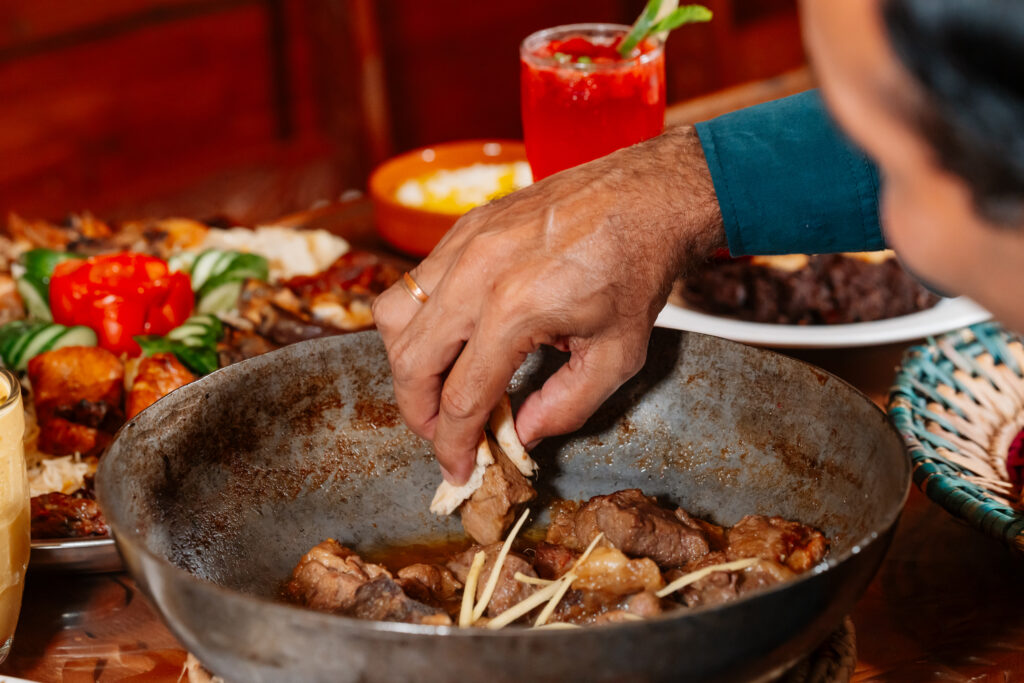
A Peshawari karahi does not need a thick layer of masala to announce itself. The pan reaches the table hot, the aroma of meat and fire rises immediately, and pieces of warm Dodai begin disappearing almost as soon as the first serving is taken.
For diners searching for mutton Peshawari karahi, the attraction is often this simplicity. Peshawari-style karahi puts the meat first, using restrained seasoning and direct heat rather than allowing a heavy gravy to dominate the dish.
At Namak Mandi UAE, this philosophy is represented by Gud Shinwari Karahi, one of the restaurant’s signature Peshawari dishes. An important distinction for diners is that Namak Mandi specifically prepares Gud Shinwari Karahi with fresh lamb, so it should not be inaccurately described as a mutton dish simply to match a search term.
The wider experience remains exactly what people are often looking for when they search for mutton Peshawari karahi: fresh meat, straightforward ingredients, live-fire cooking and a shared Pashtun Dastarkhwan.
What Does Mutton Peshawari Karahi Mean?
The term generally describes a meat-led karahi prepared in the Peshawari or Pashtun style.
Unlike curry styles built around a generous gravy, Peshawari karahi places more attention on the meat itself. Tomatoes, ginger, green chillies and salt contribute freshness and heat without turning the dish into a heavily spiced sauce.
The karahi vessel and direct cooking method are equally important. The dish is cooked and served hot, allowing the character of the meat and fresh ingredients to remain present.
There is no single recipe followed by every family or restaurant in Peshawar, so the phrase should not be treated as one rigid formula. Different cooks have their own methods and preferences.
What generally connects the style is restraint: fewer distractions, fresh meat and a cooking process that keeps the main ingredient at the centre.
Mutton and Lamb: Understanding the Difference
“Mutton” and “lamb” are sometimes used loosely in restaurant searches, particularly across South Asia and the Gulf, but technically they are not identical.
Lamb refers to meat from a younger sheep, while mutton traditionally refers to meat from a mature sheep. In some South Asian conversations, the word mutton may also be used more broadly for goat or sheep meat.
That makes it worth checking exactly what a restaurant serves.
At Namak Mandi, the brand specifically describes its signature meat offering as fresh lamb and identifies Gud Shinwari Karahi as a lamb dish.
For this reason, guests searching online for mutton Peshawari karahi can still explore the same style of meat-first Pashtun cooking at Namak Mandi, but the restaurant’s actual menu terminology should be respected.
The Simplicity Behind Peshawari Karahi
The ingredient list in Peshawari food can appear surprisingly short to someone accustomed to heavily spiced Pakistani dishes.
That simplicity is deliberate.
Coarse salt sharpens the natural flavour of the meat. Tomatoes provide freshness and body. Ginger contributes warmth, while green chillies bring clean heat.
The result should not taste empty or plain. Instead, each ingredient should have a clear purpose.
When fewer ingredients are used, there is also less room to hide mistakes. The quality of the meat, control of the flame and timing of the cook become much more noticeable.
This is why Peshawari karahi can feel intensely flavourful despite not relying on a long spice list.
Why Fresh Meat Matters So Much
A meat-led karahi depends on the quality of its main ingredient.
In a gravy-heavy dish, sauces and spices may take much of the attention. In Peshawari karahi, the diner notices the meat almost immediately: its tenderness, natural richness and the way it has responded to the heat.
Namak Mandi’s food philosophy is built around freshly sourced lamb and chicken rather than frozen shortcuts. The restaurant describes this approach simply: the meat speaks for itself.
That principle is especially important in karahi.
The dish should taste like well-prepared meat supported by tomato, chilli and ginger rather than a spoonful of masala in which the meat happens to be sitting.
Fire Is an Ingredient Too
The flavour of Peshawari karahi does not come only from what is added to the pan. It also comes from what happens underneath it.
At Namak Mandi, karahis are freshly cooked over open flame.
Direct heat helps the ingredients cook quickly and gives the dish the energetic character people associate with a freshly prepared karahi.
It also creates one of the most memorable parts of the dining experience.
You can often hear the karahi approaching before it reaches the table. The pan still holds its heat, the aroma rises immediately, and everyone instinctively begins reaching for bread.
That sensory experience is difficult to separate from the food itself.
Gud Shinwari Karahi at Namak Mandi
For diners looking to understand authentic Peshawari karahi, Gud Shinwari Karahi is the natural place to begin at Namak Mandi.
The restaurant identifies it as slow-cooked lamb prepared over fire and finished with tomato, reflecting the same meat-first philosophy seen across its Peshawari menu.
Rather than ordering several karahis on the first visit, make Gud Shinwari Karahi the centre of the table and add contrasting dishes around it.
Dodai gives you bread for the karahi.
Authentic Chapli Kabab adds a different texture.
Premium Gud Lamb Chops introduce charcoal-grilled meat.
Peshawari Pulao Mandi provides rice when the group wants a larger shared spread.
This allows guests to understand several sides of Pashtun cooking without repeating the same preparation across the table.
Peshawari Karahi Versus a Gravy-Heavy Karahi
The biggest difference many diners notice is the relationship between the meat and the sauce.
A gravy-heavy karahi may provide plenty of masala to spoon over rice or bread. The surrounding sauce becomes an important part of the dish.
Peshawari karahi tends to be more direct.
The tomatoes and other ingredients cook with the meat, but the dish is not intended to become a large bowl of gravy. The meat remains the centre of attention.
This gives the eating experience a different balance.
With a gravy-rich dish, you may find yourself reaching repeatedly for sauce. With Peshawari karahi, each piece of meat carries much more of the experience.
Neither style is inherently superior. They simply satisfy different cravings.
Why Dodai Belongs Beside the Karahi
Fresh bread is one of the most natural companions to a hot Peshawari karahi.
At Namak Mandi, Dodai and Tandoori Dodai can be placed around the Dastarkhwan so everyone can tear and share the bread.
It works particularly well because Peshawari karahi is not excessively gravy-heavy. Bread can gather the concentrated juices and fresh ingredients around the meat without the meal becoming overwhelmed by sauce.
The act of sharing the bread also matters.
One person tears a piece, another moves the karahi closer, and the table gradually becomes communal rather than organised around individual plates.
That is how the dish makes the most sense.
Chapli Kabab Adds the Right Contrast
Karahi is soft, hot and juicy. Chapli Kabab provides almost the opposite texture.
Authentic Chapli Kabab has a broad, textured surface with cooked edges that make it noticeably different from both karahi meat and Seekh Kebab.
Pairing the two creates a more interesting Peshawari meal than simply ordering two karahis.
For first-time guests, it also introduces two recognisable Pashtun cooking styles in one sitting.
A piece of Chapli Kabab can be enjoyed with Dodai or rice before returning to the hot karahi in the centre.
Add Charcoal-Grilled Lamb for a Larger Dastarkhwan
For families and larger groups, charcoal-grilled meat adds another layer to the table.
Namak Mandi serves Premium Gud Lamb Chops, Vreeta BBQ and Vreeta Dum BBQ among its lamb-focused offerings.
Where the karahi carries the character of the open flame and pan, grilled dishes introduce smoke and a firmer surface.
That gives the table three distinct experiences:
- Gud Shinwari Karahi for fresh, fire-cooked meat
- Authentic Chapli Kabab for texture
- Charcoal-grilled lamb for smoke and char
Add rice or Dodai according to the group size, and there is little need to overload the table with more meat dishes.
Peshawari Pulao Mandi for a Family Table
Rice is not essential with every karahi meal, but it becomes useful when several people are sharing.
Peshawari Pulao Mandi gives the group a generous rice dish that can sit beside the karahi and charcoal-grilled meats.
For a family of four or five, a balanced spread might include:
- Gud Shinwari Karahi
- Authentic Chapli Kabab
- Peshawari Pulao Mandi
- Dodai
- One charcoal-grilled lamb dish
The aim is variety through different cooking methods rather than sheer quantity.
For a smaller table, Gud Shinwari Karahi, Chapli Kabab and Dodai may already be enough to provide a strong introduction to Peshawari food.
Melmastia and the Way Karahi Is Shared
Peshawari Karahi is deeply suited to communal dining.
The pan is placed in the centre rather than divided immediately into individual servings. Bread moves from one side of the table to another, and different guests eat according to their own pace.
At Namak Mandi, that approach is linked to Melmastia, the Pashtun tradition of generously welcoming and honouring a guest.
Diners are treated as Mehmaan—honoured guests.
Charpai-style seating, a generous Dastarkhwan and the slower rhythm of shared food help carry that hospitality into the UAE dining experience.
Once the karahi and grilled dishes are finished, Sheena Kahwa gives the table another reason to remain together rather than rushing away.
Peshawari Karahi for Family and Group Dining
Karahi works particularly well for groups because one shared dish can become the centre of the meal.
For two or three guests, order Gud Shinwari Karahi with Dodai and one additional dish such as Chapli Kabab.
A family can add Peshawari Pulao Mandi and Premium Gud Lamb Chops.
For larger gatherings, a Mix Grill Platter or additional barbecue items can broaden the spread.
Namak Mandi also accepts bulk orders and guest event enquiries. A full roasted lamb is available by advance order, subject to confirmation directly with the branch.
This makes Peshawari food suitable not only for everyday dinners but also for birthdays, Eid gatherings, visiting relatives and corporate meals.
Where to Try Peshawari Karahi in Dubai
Namak Mandi Dubai is located in Al Nahda First, making it convenient for diners looking for traditional Pakistani and Peshawari food on the Dubai–Sharjah side of the city.
Namak Mandi Dubai – Al Nahda
Hessa Tower, Al Ittihad Street
Al Nahda First, Dubai, UAE
Opening hours: Daily, 11:00 AM–1:00 AM
Call or WhatsApp: 050 464 9204
Parking is available at Hessa Tower, and Al Nahda Metro is approximately a five-minute walk away.
The branch offers dine-in, takeaway, delivery by call, bulk orders and guest event bookings.
Peshawari Karahi in Abu Dhabi
The Namak Mandi experience is also available in Mussafah, Abu Dhabi.
Families can build a shared Peshawari meal around Gud Shinwari Karahi, Chapli Kabab, Peshawari Pulao Mandi, charcoal-grilled meats and Dodai.
A private dining room is available for family occasions, corporate groups and gatherings requiring additional privacy.
Namak Mandi Abu Dhabi – Mussafah
4th Thiqah Street, M-17
Mussafah Sanaiya, Abu Dhabi, UAE
Opening hours: Daily, 10:30 AM–12:00 midnight
Call or WhatsApp: 050 371 7639
Frequently Asked Questions
What is mutton Peshawari karahi?
Mutton Peshawari karahi generally refers to sheep or goat meat prepared in a Peshawari-style karahi with restrained seasoning, fresh ingredients and a strong focus on the flavour of the meat. Recipes vary between restaurants and families.
Is Peshawari Karahi made with mutton or lamb?
It can vary according to the restaurant. At Namak Mandi UAE, the signature Gud Shinwari Karahi is made with fresh lamb, so diners should use the restaurant’s actual menu description rather than calling it mutton.
What makes Peshawari Karahi different from regular Pakistani karahi?
Peshawari Karahi generally uses simpler seasoning and places greater emphasis on fresh meat, tomato, ginger, green chillies and direct cooking. Other Pakistani karahi styles may use broader spice combinations or produce more masala or gravy.
Where can I find Peshawari Karahi in Dubai?
Namak Mandi serves Gud Shinwari Karahi at Hessa Tower in Al Nahda First, Dubai. The restaurant is approximately a five-minute walk from Al Nahda Metro and is also convenient for diners travelling from nearby parts of Sharjah.
What should I order with Gud Shinwari Karahi?
Fresh Dodai is the most natural starting point. For a larger meal, add Authentic Chapli Kabab, Peshawari Pulao Mandi and Premium Gud Lamb Chops to experience different Peshawari cooking styles.
Does Namak Mandi serve Peshawari Karahi in Abu Dhabi?
Yes. Namak Mandi also operates in Mussafah, Abu Dhabi. Guests can enjoy the brand’s Peshawari menu and arrange family meals, bulk orders or private dining enquiries through the Abu Dhabi branch.
Experience Mutton Peshawari Karahi Flavour the Namak Mandi Way
If your search for mutton Peshawari karahi is really about finding that unmistakable Pashtun combination of fresh meat, simple seasoning and fire, gather around the Dastarkhwan at Namak Mandi.
At Namak Mandi, the signature Gud Shinwari Karahi is prepared with lamb, staying true to the restaurant’s meat-first Peshawari philosophy. Pair it with warm Dodai, Authentic Chapli Kabab and charcoal-grilled lamb for a meal built around contrast rather than heavy masala.
Call or WhatsApp 050 464 9204 to reserve a table, arrange a family meal or discuss a group order at Namak Mandi Dubai.
For Abu Dhabi bookings, private dining and group enquiries, contact Namak Mandi Mussafah on 050 371 7639.
Explore the menu at www.namakmandidubai.com. Follow @namakmandidubai and @namakmandi.abd on Instagram for sizzling karahis, Peshawari food and restaurant updates.
Bring your Mehmaan. Tear the Dodai. Let the karahi speak for itself.
This Is Not Just Food. This Is Peshawar.

